
- This event has passed.
Dream Theater + Devin Townsend & Animals As Leaders at Arizona Financial Theatre
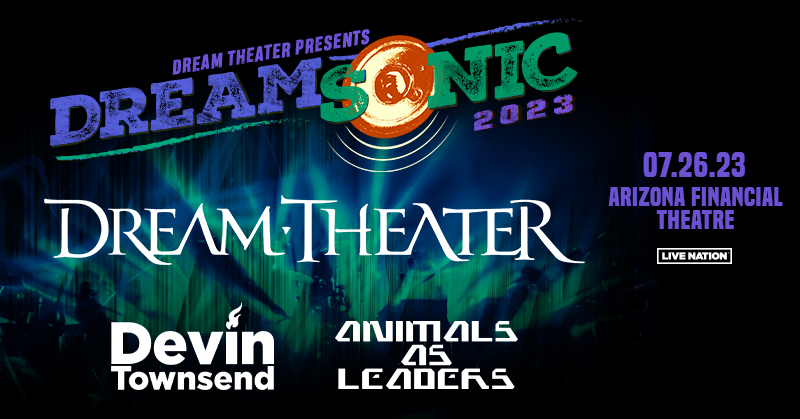
Long Island, New York’s Dream Theater are the globally celebrated standard bearers for progressive metal in the 21st century. Their ability to deliver tight, melodic, musically sophisticated songs and thematic concept recordings encompassing elements of hook-based hard rock, riff-fueled metal, syncopated prog, and refined lyrics have made them the act others are measured by. Their second album, 1992’s Images and Words, established their sonic signature, while 1994’s Awake and 1999’s Metropolis, Pt. 2: Scenes from a Memory cemented their place in metal’s pantheon. Dream Theater is well known for high-energy concert performances. While they’ve released several 21st century live albums — Live at the Marquee, Live in Japan, and Live Scenes from New York — they remain one of the genre’s most bootlegged bands. For 2016’s The Astonishing, a double-length dystopian sci-fi opera, they were accompanied by the Prague Symphony Orchestra and three choirs. In 2021, the band issued A View from the Top of the World.
Originally named Majesty (from a lyric in “Bastille Day”), the band was founded by Berklee College of Music students guitarist John Petrucci, bassist John Myung, and drummer Mike Portnoy; they soon expanded with the addition of keyboard player Kevin Moore and vocalist Chris Collins. Releasing an eight-tune demo, Majesty Demo, as Majesty, the group sold 1,000 copies within six months. The departure of Collins in late 1986 left Majesty without a vocalist, and after a long period of auditioning possible replacements, the group settled on Charlie Dominici in November 1987. They decided to change their name to Dream Theater, inspired by a now-demolished California movie theater. Signing with Mechanic Records, the group began working on their first full-length album. Delays caused by label mismanagement limited the group to performing at small clubs and bars. Frustrated by this experience, Dream Theater finally severed its ties with Mechanic.
This was only one drastic change in the band’s course of action. Firing Dominici, the group spent the next couple years searching for a vocalist. The search ended in late 1991 when a demo tape from Canadian vocalist James LaBrie, formerly of Winter Rose, arrived. After flying to New York to audition, LaBrie was invited to join the band. Signing with Atco Atlantic (which came to be known as East West), Dream Theater released its second album, Images & Words, in 1992. One of three videos based on songs from the album, “Pull Me Under,” became an MTV hit. Although Theater showed considerable growth with their third studio album, Awake, recorded between May and July 1994, the group continued to be hampered by personnel changes. Before the album was mixed, keyboardist Moore left the group to focus on his solo career. Hired as a temporary replacement for the band’s Waking Up the World tour, Derek Sherinian later became a permanent member. His first recording with Dream Theater was a 23-minute epic, “A Change of Seasons,” written in 1989 and released in September 1995 on the album of the same name.
Following a mini tour, Fix for ’96, the members of Dream Theater separated for several months and became involved with a variety of outside projects. Petrucci was the busiest. In addition to joining Portnoy and keyboard player Jordan Rudess in the Liquid Tension Experiment — a group that included influential bassist/stick player Tony Levin — Petrucci played guitar with Trent Gardner’s Explorers Club and made a guest appearance on Shadow Gallery‘s Tyranny album. Myung and Sherinian collaborated with King’s X vocalist Ty Tabor in the band Platypus. LaBrie worked with Mull Muzzler, a group formed with Matt Guillory and Mike Mangini.
Dream Theater experienced yet another change when Rudess was tapped to replace Sherinian, who had been fired in 1999. The band released the progressive rock-heavy Scenes from a Memory that year, a conceptual piece that followed the story of the 1928 murder of a young woman and how a modern man is haunted by the crime. It was followed by Live Scenes from New York in 2001, which suffered from an unintentional bout of controversy when its original cover featuring the city of New York in flames was pulled due to the events of September 11. The group continued in the progressive metal vein in 2002 with Six Degrees of Inner Turbulence, followed by the leaner Train of Thought in 2003 and Octavarium in 2005. The live album Score: XOX was released in 2006 and featured the band backed by a 29-piece orchestra. It was followed a year later by the new studio album Systematic Chaos, and in 2009 by Black Clouds & Silver Linings.
Sherinian went on to record as a soloist and to play with a prog and jazz fusion band, Planet X. Petrucci released an eponymously titled solo album in 2003, featuring accompaniment by Dave LaRue of the Dixie Dregs and Boston-based drummer Dave DiCenso. In late 2010, Mike Mangini joined the group, replacing drummer Mike Portnoy, who left the band in September of that year. With a rigorous touring schedule that firmly broke in Mangini, Dream Theater somehow found time to record. They pre-released the track “On the Backs of Angels” on YouTube via their label, Roadrunner, in June of 2011, followed by the CD release of the aptly titled full-length A Dramatic Turn of Events in the fall. After a period of rigorous international touring, the band took a break, though its members continued writing. They reconvened in early 2013 and returned with a self-titled studio album in September — this one with Mangini completely involved in the writing process — followed in November with the concert recording Live at Luna Park on CD and DVD, which was recorded during the Dramatic Turn of Events tour over two nights at the Buenos Aires soccer stadium. Recorded live at the Boston Opera House on March 24, 2014, the concert recording Breaking the Fourth Wall arrived the following year, and in late 2015 the band announced their upcoming 13th studio album, The Astonishing. A completely conceptual sci-fi offering, it was released in January 2016. After a world tour in which they performed the whole of the album, the band took an extended breather. At the end of 2018, Dream Theater released the single and video for “Untethered Angel” in advance of a North American tour. The full-length Distance Over Time was the first album by the band to clock in at less than an hour in length in over a decade. Petrucci credited the more economical running time to a more collaborative writing process that took a mere 18 days to complete, and focused on harder-edged songs than on more recent recordings. Distance Over Time was released by Inside Out in early 2019. Taking the album on the road, Dream Theater played a sold-out show at London’s Apollo, which was recorded for prosperity.
Released in November 2020, Distant Memories: Live in London, not only featured live tracks from the album but a 20th anniversary celebration of their 1999 concept album, Metropolis, Pt. 2: Scenes from a Memory. In 2021, the band returned with A View from the Top of the World. Its seven extended tracks ranged from just over six to 20 minutes and comprised — for the first time in many years — an aural portrait of the band mapping out prog metal architectures and compositions without a guiding concept or theme. ~ Craig Harris, Rovi
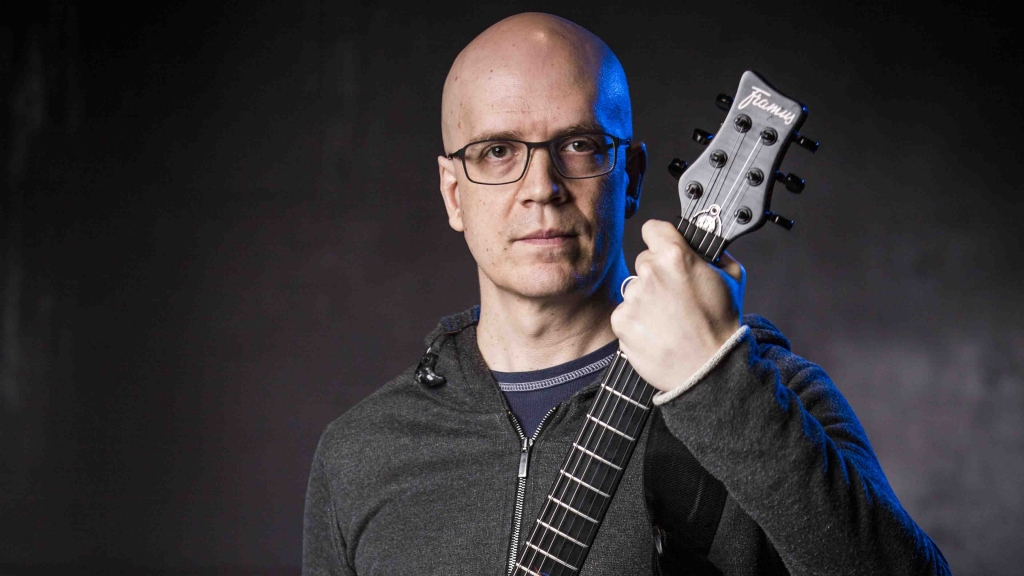
Canadian progressive metal singer and guitarist Devin Townsend has been referred in the rock press as a “multi-everythingist”; in addition to being a celebrated instrumentalist, he is a composer, producer, arranger, and bandleader. While his earliest recorded appearance was as a vocalist with Steve Vai‘s band on Sex & Religion, he also worked with Front Line Assembly and Skinny Puppy, and led the almost unbearably heavy extreme metal group Strapping Young Lad. His recorded solo work since 1997’s rocking sci-fi opus, Ocean Machine (Biomech), has been hotly debated in extreme music circles. He has recorded more than two dozen solo studio and live albums with a variety of musicians. His undeniably progressive, shape-shifting conceptual outfit the Devin Townsend Project is perhaps the best-known of his outlets; their albums Ki (2009), Ziltoid (Dark Matters) (2015), and Transcendence (2016), reveal Townsend delivering his ambition in unified, accessible, and provocative projects readily embraced by the metal and prog-rock communities. The solo album Empath appeared in 2019. The Puzzle/Snuggles double appeared in 2021 followed by Lightwork in 2022.
Townsend was born May 5, 1972 in Vancouver, British Columbia. After picking up the banjo at age five, he moved to guitar at 12, and within a few years was leading the band Grey Skies, later known as Noisescapes. Sending the group’s demo to the Relativity label, Townsend was not only offered a solo deal but was also tapped to sing on Steve Vai‘s 1993 LP Sex & Religion, a collaboration that further extended to the guitar god’s 1996 effort Fire Garden. In between, Townsend worked on a series of projects with Front Line Assembly, and in 1995 issued the solo Heavy as a Really Heavy Thing under the alias Strapping Young Lad. A stint with the satiric punk band Punky Bruster yielded the Cooked on Phonics LP before Townsend began work on the second Strapping Young Lad album, 1997’s City. In a move away from the industrial and death metal of previous recordings, he next formed Ocean Machine — with J.R. Harder and Marty Chapman — for the accessible Biomech, which was issued later that year.
Townsend’s first solo album to be released under his own name was 1998’s Infinity, and it directly followed a difficult period for the artist, in which he was diagnosed with bipolar disorder. He would later identify his condition as an explanation for the difference in sound and approach between Strapping Young Lad and Ocean Machine. 2000 saw a mentally stronger Townsend release the sharp, focused, and melodic speed metal album Physicist, while 2001’s Terria channeled an ambient pop sound. February 2003 brought an eponymous Strapping Young Lad record which returned to a traditional death metal template. Sessions for this release took place during the same period as those for the acclaimed first album under the Devin Townsend Band moniker, Accelerated Evolution. This record was issued just a month after the SYL release, and Townsend received praise for creating a modern metal album that wasn’t afraid to nod to ’70s and ’80s arena rock in a post-grunge world. While 2006’s Synchestra didn’t quite reach the same high standard, Townsend continued to keep things fresh by following a straight-up ambient record — The Hummer — with Ziltoid the Omniscient, a rock opera about an alien who travels to Earth in search of “the ultimate cup of coffee.”
In the immediate years that followed Ziltoid, Townsend took a break from the music industry to rest, recharge, and rediscover the cathartic aspect of composition. In March 2009, a shaven-headed, teetotaling Townsend announced an intended four-album sequence from the Devin Townsend Project, billed as an opportunity to show that he could create new music without the assistance of drugs. The strongest of these four releases was November 2009’s Addicted, on which he collaborated with former Gathering vocalist Anneke van Giersbergen. Giersbergen returned for a central role on an unexpected fifth Devin Townsend Project album in 2012, the pop-infused Epicloud. In 2014, Townsend released the ambitious Z², a double album that featured a Devin Townsend Project album, Sky Blue, and a conceptual album, Dark Matters, the latter of which was a sequel to 2007’s Ziltoid the Omniscient. 2015 saw the release of Ziltoid: Live at the Royal Albert Hall, a recording of Townsend’s performance at the prestigious London venue in April of that year. Despite a claim that he was taking a year off, Townsend kept writing and recording. In March of 2016 he announced a new DTP album titled Transcendence. It was released in September, and after a tour, he disbanded the outfit. Over the next several years, Townsend toured selectively with his various shape-shifting bands, issued three separate volumes of his catalog on vinyl, and began writing his most ambitious project. Titled Empath, Townsend prefaced its release with a social media warning to fans: “Some of you won’t like it. Some of you will be very confused by it. Some of you will be alienated by it.” The reason for the statement was that in the past, Townsend always recorded albums to showcase where he was at any given time — even if it meant that he would be showcasing a wide variety of styles on an album. With 2019’s wildly diverse and exotic Empath, he chose to create an offering that would depict, under a single sonic umbrella, every musical space he’d inhabited up to the present time — sometimes within a single track — in order to point his way forward. His guest list for the date included Mike Keneally as his music director, former boss Steve Vai, the Elektra Women’s Choir, Casualties of Cool partner Ché Aimee Dorval, Anneke Van Giersbergen, drummers Morgan Ågren, Anup Sastry, and Samus Paulicelli, and Chad Kroeger — the Nickelback vocalist who convinced Townsend to undertake Empath in the first place. Upon release, the set was greeted by mostly positive reviews, but in true Townsend fashion, he claimed to agree equally with critical and affirmative ones. A live rendition of the album, Order of Magnitude: Empath Live, Vol. 1, arrived in October 2020.
In December 2021, Townsend released The Puzzle/Snuggles, his 19th and 20th albums, simultaneously. The former is “an elaborate and much more chilled out” version of 2004’s Devlab, and “more a collaborative, multimedia internet art project.” The latter was “meant to be something you listen to in order to feel better… Puzzle is chaos, Snuggles is calm.” The entire project was meant to express Townsend’s impression that he felt light at the end of a dark tunnel imposed on the world by the pandemic.
The following November, Townsend issued Lightwork. Assembled from a compendium of material written during quarantine, he enlisted veteran first-call producer Garth Richardson to assist in bringing these more traditional, song-oriented sessions to fruition. Lightwork appeared in several editions: the standard ten-track album was appended by a deluxe version that doubled the track list and included the bonus album companion album Nightwork. ~ Jason Ankeny & James Wilkinson, Rovi
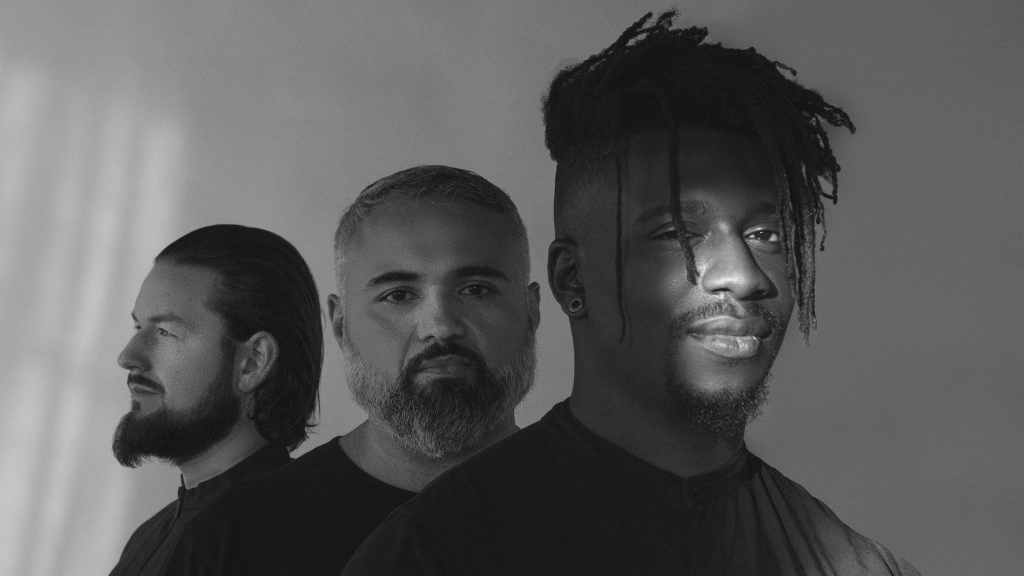
It might sound strange to associate “storytelling” with instrumental music. But ANIMALS AS LEADERS jettisoned the rules, limitations, and boundaries of conventional rock music from the start. Armed with palette-expanding eight-string guitars, rich synths, and pummeling percussive grooves, the trio is beloved by metalheads, aspiring virtuosos, jazz fanatics, and casual listeners alike. As Pitchfork observed, “Animals As Leaders have walked the tightrope between sheer technical virtuosity and actual emotional resonance.” Even without vocals, this is intimate, mythmaking music. Animals As Leaders began as a solo outlet for guitarist Tosin Abasi, whose creative partnership with classically trained guitarist Javier Reyes and Berklee-educated drummer Matt Garstka is built on a shared love of everything from fusion to technical death metal. Garstka graced the cover of Modern Drummer in 2015. In one of his many appearances on their cover, Guitar World named Tosin among the Guitarists of the Decade. Rolling Stone featured him as part of their “Young Guns” series. The Chicago Tribune declared him “the closest thing prog-metal has to an Eddie Van Halen.” Quickly ascending beyond the traditional confines of instrumental rock, Animals As Leaders owe much to their unique blend of precision and feel, both in abundance on album five, PARRHESIA. The trio remain connected to their fiercely engaged audience via captivating shows and projects.